


Key points
- Overall increase in the amount of R&D tax relief claimed to £8.2 billion.
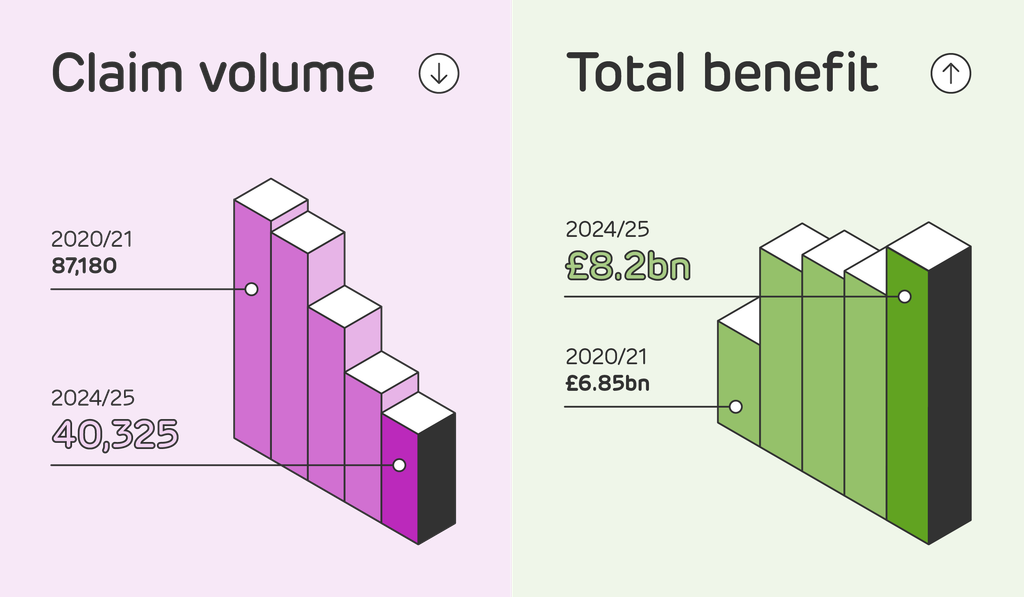
- While the total benefit increases, claim volume declines by 17%.
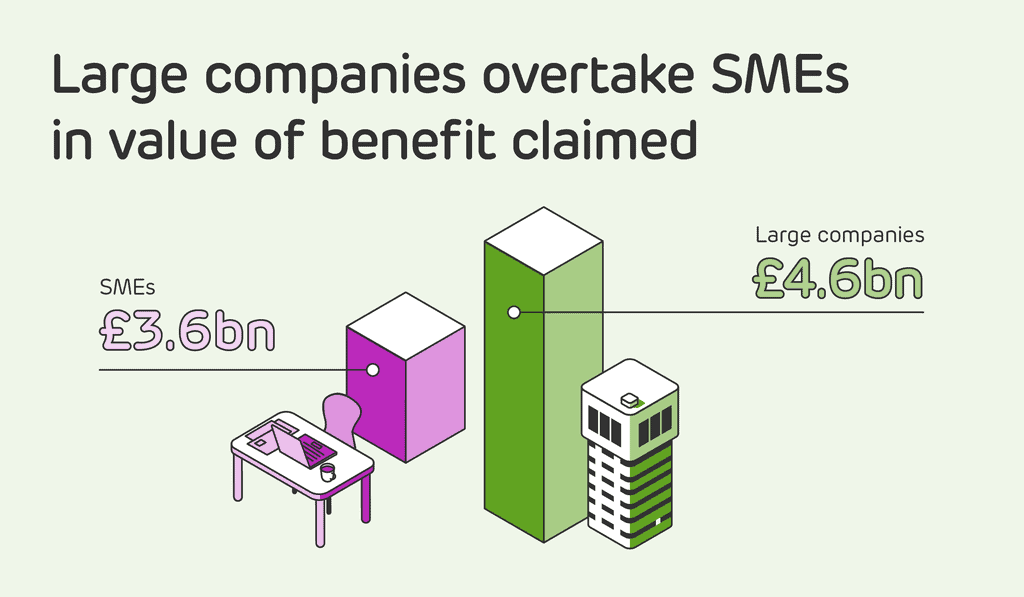
- Large companies claim more in value than SMEs for the first time.
HMRC has today published its annual statistics for R&D tax credits, offering an insight into the impact of this powerful incentive.
The statistics cover the tax year 2024/25, reflecting a period that saw the continued impact of rate changes and claim notification, targeted compliance efforts, the introduction of the merged scheme, and a reduction in the R&D intensity threshold for Enhanced R&D Intensive Support (ERIS).
The statistics largely consolidate previous trends, in addition to providing some notable insights on first-time claimants and the proportion of the relief claimed by SMEs versus large companies.
R&D expenditure has increased
Total number of R&D claims has decreased
The average claim value has increased
R&D claims decrease, but value increases
The total relief claimed for the financial year 2024/25 is £8.2 billion, an increase of 5% from 2023/24. This equates to £51 billion of R&D expenditure claimed – a 7% increase on 2023/24.
At first glance, this appears to be a positive increase, following an anticipated 1% decrease in total R&D expenditure when the 2023/24 figures were initially released (a figure that was subsequently revised to a 2% increase). However, this figure will likely be impacted by a broader range of downstream subcontractor costs coming into scope under RDEC. Similarly, the increase in the overall relief claimed will reflect the increase in the headline RDEC rate from 13% to 20%.
Of the £8.2 billion claimed, £2.3 billion was claimed across the SME and ERIS schemes and £5.9 billion claimed through the RDEC and merged RDEC schemes. Large companies received £4.6 billion of relief across the schemes, while SMEs received £3.6 billion.
From a claim volume perspective, the total number of R&D claims for 2024/25 was 40,325, a fall of 17% and the lowest number of claims in a decade, largely driven by a 19% decrease in claims made by SMEs. Conversely, the average claim value increased by 27% in 2024/25, accounted for by claims over £2 million rising by 21% in value compared to the previous year. Overall, just 6% of claims accounted for 69% of the total value in 2024/25.
Impact of the Additional Information Form
HMRC attributes the decrease in claim volume to the continuing impact of the additional information form (AIF) – introduced in August 2023 as a procedural requirement designed to help combat error and fraud.
That HMRC should put such emphasis on the AIF is interesting. Our own experience indicates that most companies we advise were already submitting supporting reports including project descriptions with their claims, making the AIF a continuation of existing practice in most cases. It’s likely that for many businesses, the increased administrative burden of the AIF coupled with claim notification and compliance risk have created a de facto de minimis, which we can see in the stark reduction in claims under £25k, which are down 23% year on year.
Large company relief surpasses SME relief for the first time
A key theme from last year’s statistics was the amount claimed under RDEC surpassing SME claims for the first time (£4.41 billion v £3.15 billion). This was in part owing to the increase in the RDEC rate from 13% to 20%.
This year’s statistics point to large companies claiming more in value than SMEs for the first time, with large companies claiming £4.6 billion of relief compared to £3.6 billion claimed by SMEs.
This is reflected in average claim values, with the average claim made by a large company being £1.2 million, up by 19% from £1 million in 2023/24. SME claim value by comparison stood at £98k, up from £91k in 2023/24 – an uplift of 9%. SME intensive/ERIS claims have increased from 4,030 in 2023/24 to 4,965 in 2024/25, likely reflecting the positive impact of reducing the intensity threshold from 40% to 30% and the removal of subsidy restrictions.
The shift in value towards large companies can potentially be attributed to a range of factors, including new rules relating to contracted-out R&D under the merged scheme, which in some cases, move the right to claim up the supply chain; more downstream subcontractors coming into scope under RDEC; and the continued impact of the increase in the headline rate of RDEC. Overall, the combined impact of these changes makes it more attractive for large companies to claim.
We are likely also seeing legitimate claimants at the lower end of the market deciding not to claim as a result of increased procedural complexity, heightened compliance environment and rate changes.
Impact on first time claimants
One of the key trends to emerge from the release is the continued reduction in first-time claimants. This group has declined substantially since its 2018/19 peak of 19,720, to stand at 5,250 for 2023/24. This reflects a significant year-on-year decline of 43% and marks the fifth consecutive year that the overall number of first-time applicants has gone down.
Interestingly, for 2024/25, HMRC gives a provisional figure, indicating that it expects first-time claims will again begin to climb to a projected level of 5,850. It’s unclear what sits behind this projection, particularly since the next set of data will reflect the full effect of claim notification – something that has a significant bearing on first time claimants.
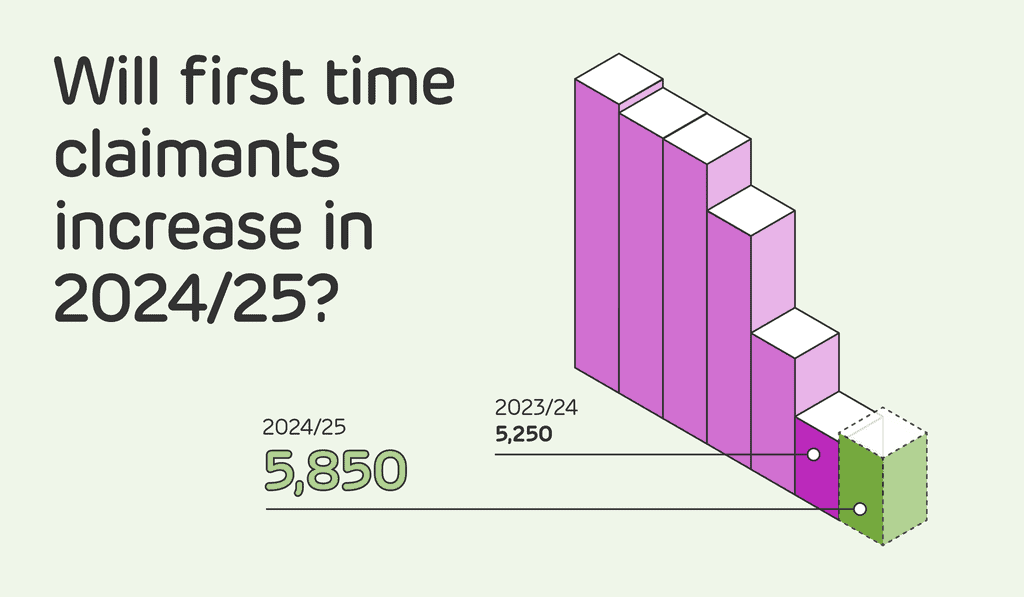
We would instead expect 2024/25 to again show a reduction when the full effect of claim notification is taken account of and for the figures to (hopefully) rise again in the following year once the initial impact of claim notification subsides.
Sector and regional picture remains unchanged
Sectors: In line with the overall downward trend in claims, claims are down across all sectors, with five sectors seeing a decrease of over 75% since the 2021 to 2022 financial year. These are accommodation & food; real estate; education; wholesale & retail trade, repairs; and health & social work. Each are areas where significant volumes of R&D aren’t typically seen and where, historically, HMRC’s ISBC compliance unit has focused its compliance efforts.
Last year we noted that around two thirds of relief was concentrated in three key Standard Industry Classification (SIC) codes synonymous with innovation (Professional, Scientific & Technical, Information & Communication, and Manufacturing). They remain the top performing sectors again this year.
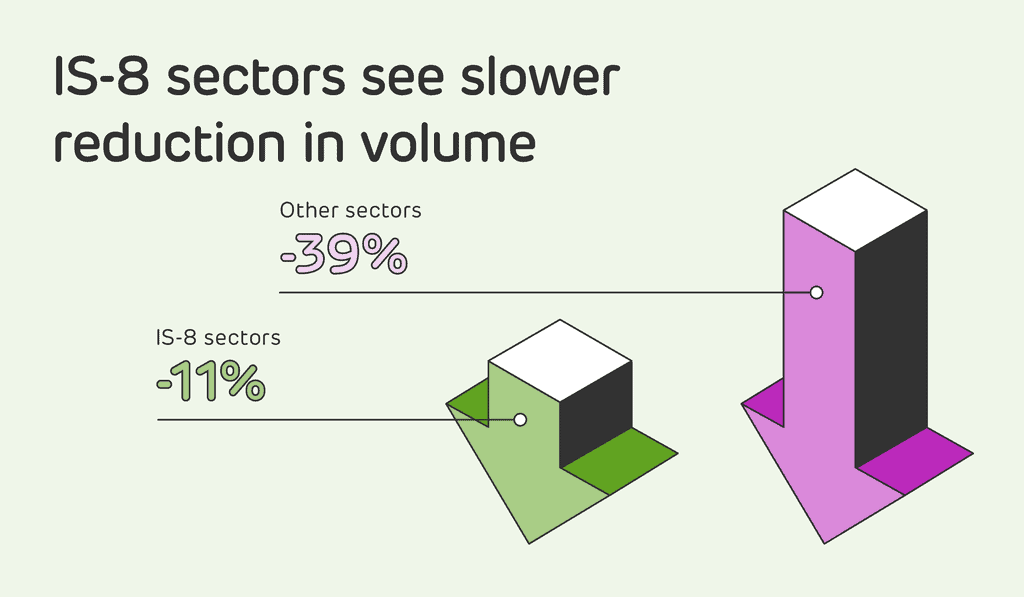
While they don’t directly align, we are able to closely map the eight industrial strategy (IS-8) sectors, where the government is targeting growth, and note a slower rate of claim reduction. Although positive that these sectors have declined at a slower rate, we would hope to see an uptick in future years as targeted efforts to stimulate growth in key IS-8 sectors bed in.
Regions: There were falls across all regions, with slightly higher percentage drops in the West Midlands and Wales. This was in contrast to last week’s Patent Box statistics, where we saw regional pockets of uptake for the incentive emerge.
The top regions for R&D claims remain London (24% of total claims and 30% of total amount claimed), and the South East (15% of total claims and 19% of total amount claimed). It’s important to note though that the registered office location may not be where all the R&D activity takes place.
Next year – what can we expect?
As the effect of the recent changes continue to bed in, we expect to see many of the changes reflected here continue. This time next year, we’ll have a full year of merged scheme data, which will give us a more complete picture of how recent changes are working.
We’ll see whether HMRC’s predicted uptick in first time claimants is confirmed and whether the trend towards higher value claims continues in future years. It will also be interesting to see whether the government’s IS-8 sectors (and the regions aligned to them) begin to outperform.

ForrestBrown’s expert team can help unlock the value of your innovation.
We offer unrivalled technical expertise for businesses looking to access innovation incentives.