

Our technical experts don’t just help validate R&D, they live and breathe it. This three-part mini-series lifts the lid on the projects our team is working on in their spare time. First up, associate director and engineering specialist, Robin Taylor.
Robin Taylor BEng MIED leads ForrestBrown’s team of industry-experienced technical specialists, who are responsible for qualifying R&D for tax relief purposes. He is passionate about innovation and has worked at the cutting edge with household names such as Toyota, Aston Martin, Bentley and Dyson.
That passion for innovation goes far beyond the day job. It intersects his private life, where Robin embraces R&D alongside another great passion: cycling.
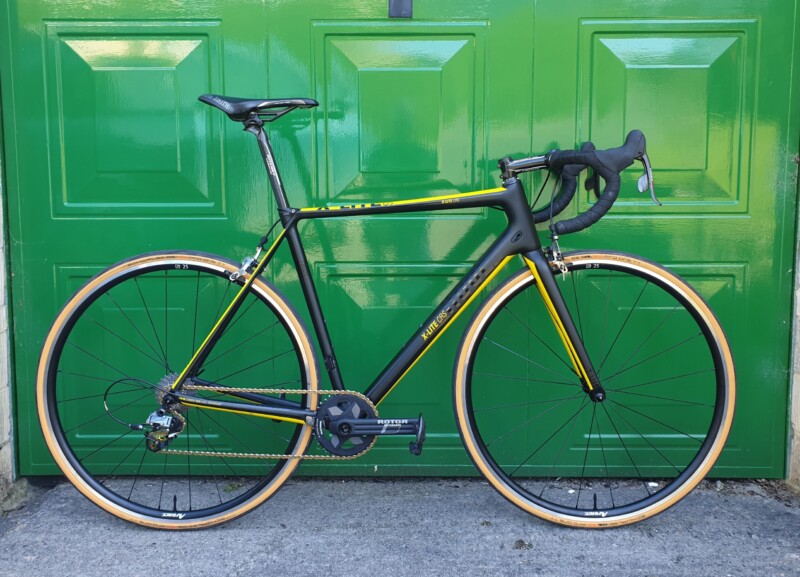
Already a fan of hills, Robin wanted to start hill climb racing and decided to take on a project to modify his bicycle to make it more competitive. His goal was straightforward: to achieve a bike weight of less than 6 kg. This project was about finding practical ways to enhance performance without breaking the bank, combining his cycling hobby with his engineering expertise.
An uphill climb
When it comes to hill climb racing, the lighter the bike, the faster you can go. However, achieving a lightweight bike usually comes with a hefty price tag. Off the shelf bikes with competitive weights of around 6 kg can cost tens of thousands of pounds. More budget-friendly options, on the other hand, are significantly heavier at around 8 to 9 kg, which when racing can be as much of a psychological barrier as a physical one. While there are regulations for hill climb races, unlike most professional cycling events, weight restrictions are not among them. Although I could have focused on shedding some pounds myself, the engineering challenge of creating a lighter bike was far more appealing!
I already had a road bike with a frame that was considered relatively lightweight, so I decided to use it as the base for the project. In its existing form, the bike weighed well over 7 kg. While this wasn’t a bad starting point, it was quite a way off my 6 kg target.
I researched potential components, focusing on weight, cost, and compatibility. Hours of internet searching uncovered some great finds with end-of-line and second-hand parts, which helped keep costs down. I kept track of each purchase, noting the weight and cost in a spreadsheet to monitor progress. Once I had all the parts, I got busy assembling and testing each one for fit and function.
Mixing and matching parts from different brands brought its own set of challenges, making sure everything worked well together. The drivetrain setup was a real grind (excuse the pun) and it took several attempts to stop the chain from jumping to get everything running smoothly.
What is a technical specialist?
Drawn from a wide range of industry backgrounds, ForrestBrown’s technical specialists are responsible for assessing whether a business’s project qualifies as R&D for tax relief purposes. They help to articulate scientific and technical R&D projects through case studies and act as the bridge between a company’s competent professional and HMRC.
ForrestBrown’s technical specialists collaborate closely with our tax experts and are drawn from industries including engineering, software, geophysics and pharmaceuticals.
Racing to the finish line
After months of research, experimentation, and assembly, I was close to my target with the bike weighing in at 6.1 kg – so close! This setup used a tubeless system, which removed the weight of the inner tube but required a more robust and consequently heavier tyre, plus sealant. When I re-evaluated each component, I saw an opportunity to further reduce the wheel’s weight. By transitioning to lightweight inner tubes and incorporating minimal spoke plugs, each weighing less than a gram, I shaved off another 100 grams, finally hitting the magic number – 5.9(95) kg.
Despite achieving my goal, the bike will probably never be “finished.” But for a fraction of the cost of buying one straight off the shelf, I had a machine that would be competitive at the start line. Now, the challenge is making sure the rider is just as competitive, but that’s a story for another day.
Interested in becoming a technical specialist?
If you’re interested in finding out more about becoming a technical specialist at ForrestBrown, why not get in touch? You can also keep an eye on our current vacancies for opportunities.